| 일 | 월 | 화 | 수 | 목 | 금 | 토 |
|---|---|---|---|---|---|---|
| 1 | 2 | 3 | 4 | |||
| 5 | 6 | 7 | 8 | 9 | 10 | 11 |
| 12 | 13 | 14 | 15 | 16 | 17 | 18 |
| 19 | 20 | 21 | 22 | 23 | 24 | 25 |
| 26 | 27 | 28 | 29 | 30 | 31 |
- memorization
- visiontransformer
- Programmers
- flow matching
- unlearning
- rectified flow
- 3d editing
- 3d generation
- Python
- 코테
- diffusion models
- VirtualTryON
- Machine Unlearning
- image editing
- flow models
- 논문리뷰
- diffusion model
- video generation
- 프로그래머스
- rectified flow models
- flow matching models
- BOJ
- image generation
- Concept Erasure
- inversion
- diffusion
- rectified flow matching models
- 네이버 부스트캠프 ai tech 6기
- ddim inversion
- video editing
- Today
- Total
평범한 필기장
[평범한 대학원생이 하는 논문 간단 요약] Back to Basics : Let Denoising Generative Models Denoise (ArXiv 2511) 본문
[평범한 대학원생이 하는 논문 간단 요약] Back to Basics : Let Denoising Generative Models Denoise (ArXiv 2511)
junseok-rh 2026. 3. 4. 22:56https://arxiv.org/abs/2511.13720
Back to Basics: Let Denoising Generative Models Denoise
Today's denoising diffusion models do not "denoise" in the classical sense, i.e., they do not directly predict clean images. Rather, the neural networks predict noise or a noised quantity. In this paper, we suggest that predicting clean data and predicting
arxiv.org
Abstract
Abstract를 가볍게 요약하면 아래와 같다.
- Clean image를 예측하는 것과 noise의 양을 예측하는 것은 다르다 $\rightarrow$ clean image를 예측하는게 manifold assumption에 맞다(?)
- 이에 맞는 Just image Transformer (JiT)를 제안한다.
1. Introduction
기존의 diffusion model들은 noise prediction ($\epsilon$-prediction)을 하거나 flow velocity prediction ($v$-prediction)을 했다. Clean image prediction ($x$-prediction)은 이 둘과 관련이 있기 때문에, $\epsilon$과 $v$를 reformulation을 통해서 구할 수 있었다. 이를 통해서 기존에는 network가 어떤 것을 prediction하는지에 대해서 덜 관심을 가졌다.

"(high-dimensional) data lie (roughly) on a low-dimensional manifold"라는 기존 manifold assumption에 따르면, clean data는 low-dimensional manifold에 놓이는 것으로 모델링될 수 있지만 noised quantity는 full high-dimensional space에 분포된다. 그래서 clean image를 예측하는 것은 noise나 noise quantity를 예측하는 것과 다르다.
기존 diffusion model들은 latent space에서 동작하기 때문에, limited-capacity network이 noise를 예측하는데 어려움이 완화되지만 이는 해결된 것이 아니라 숨겨진 것이다. 그래서 이들은 pixel이나 high-dimensional space에서는 curse of dimensionality를 다루는데 어려움을 겪는다.
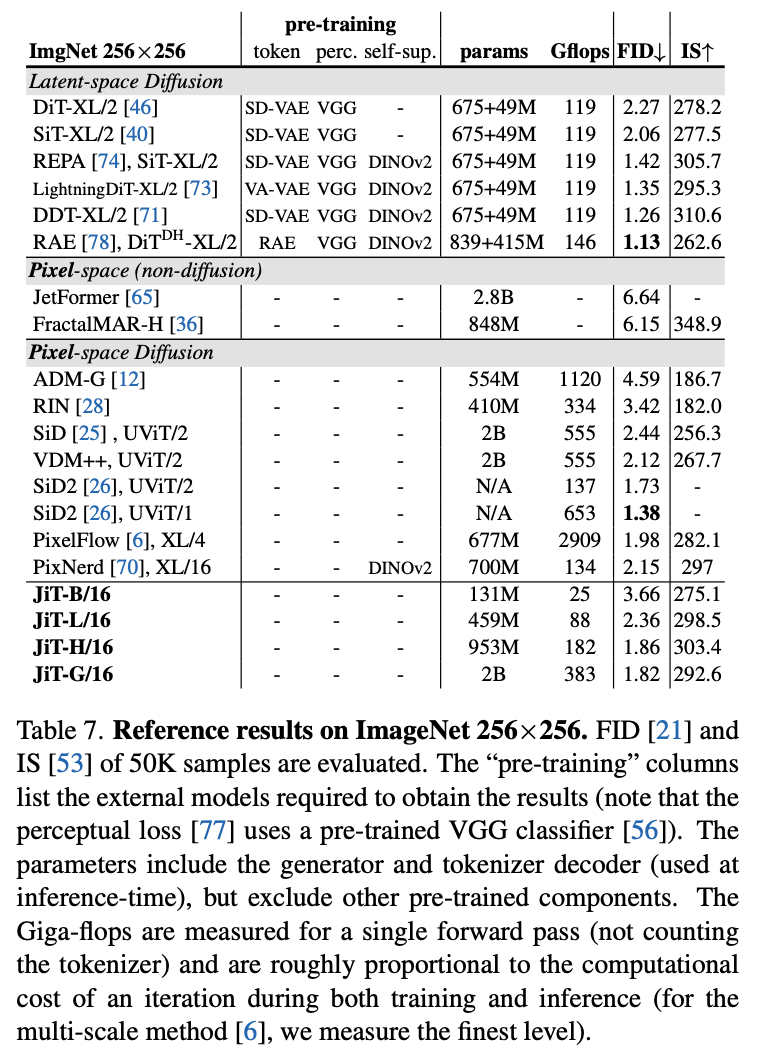
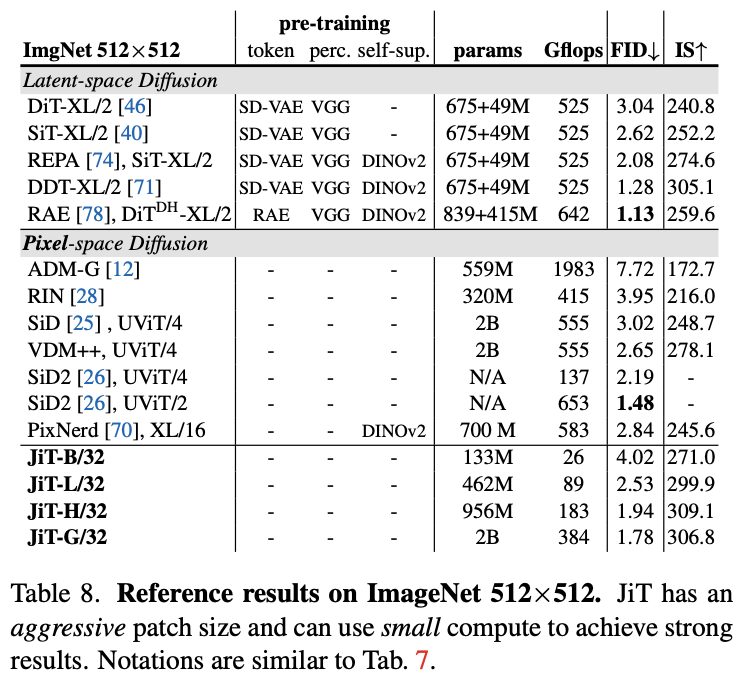
이를 해결하기 위한 기존 연구들이 존재하지만, 본 논문에서는 raw pixel들로 구성된 larget image patch들에 대해 작동하는 plain ViT가 effective diffusion modeling일 수 있다는 것을 보인다. 본 논문의 방식은 self-contained이며 pre-training과 auxiliary loss에 의존하지 않는다 - no latent tokenizer, no adversarial loss, no perceptual loss, no representation alignment. 본 논문의 model을 Just image Transforme (JiT)라고 부른다.
2. On Prediciton Outputs of Diffusion Models
2.1 Prediction Space and Loss Space
Prediction Space.
Diffusion model은 크게 $x, \epsilon, v$-prediction이 존재한다. Network이 $x$를 output으로 내놓는다고 하면 다음과 같이 나타낼 수 있다.

즉, $x_\theta$와 $z_t$로부터 $\epsilon_\theta, v_\theta$가 계산될 수 있다.
Loss Space.

위 loss를 $v$-loss라고 한다. 그렇다면 $v$-loss와, $x$-pred를 조합하면 아래 table에서 (a)가 된다.
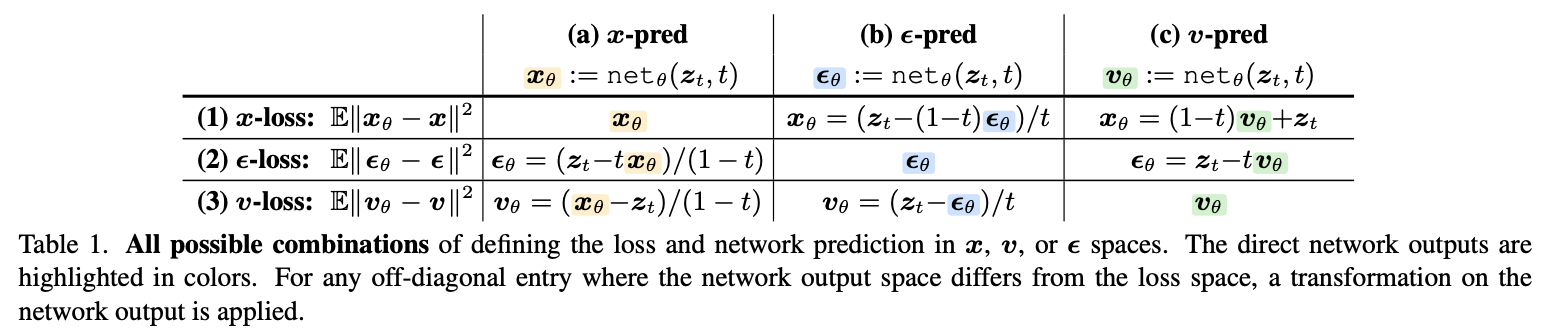
$v$-loss와 $x$-prediction을 조합하면, (3)은 $\mathcal{L} = \mathbb{E} \Vert v_\theta(z_t, t)-v\Vert^2 = \mathbb{E}\frac{1}{(1-t)^2} \Vert x_\theta(z_t,t) - x \Vert^2$가 된다. 이는 $x$-loss의 reweighted 형태이다. 이를 통해 table 1처럼 9개의 조합을 만들 수 있다. 이 조합들이 모두 수학적으로 동일하지 않다고 한다.
Generator Space.
Inference시에 모두 v-space로 변환시킬 수 있기 때문에, 모두 다음 ODE를 풂으로써 샘플링할 수 있다.

2.2 Toy Experiment
Figure 1에서처럼 noise $\epsilon$과 velocity $v$는 off-manifold인 반면 data $x$는 low-dimensional manifold에 존재한다. 그래서 network가 clean data $x$를 직접 prediction하도록 하는 것이 더 tractable하다. 이를 보이기 위해서 본 논문에서는 toy experiment를 진행한다.

본 논문은 256-dim의 hidden unit을 가진 5-layer ReLU MLP로 학습한다. 위 결과를 보면, $x$-prediction만이 D가 증가할 때, 적절한 결과를 생성한다. 이는 true data는 low-dimensional d-dim space에 존재하기 때문이다. $v, \epsilon$-prediction은 전체 dimension이 512면 model이 512차원을 나타내야하는데, 모델의 용량이 256이기 때문에 이를 표현할 수 없다. 그러나 $x$-prediction은 output의 차원인 2차원만을 표현하면 되기 때문에, 잘 표현한다.
3 "Just Image Transformers" for Diffusion
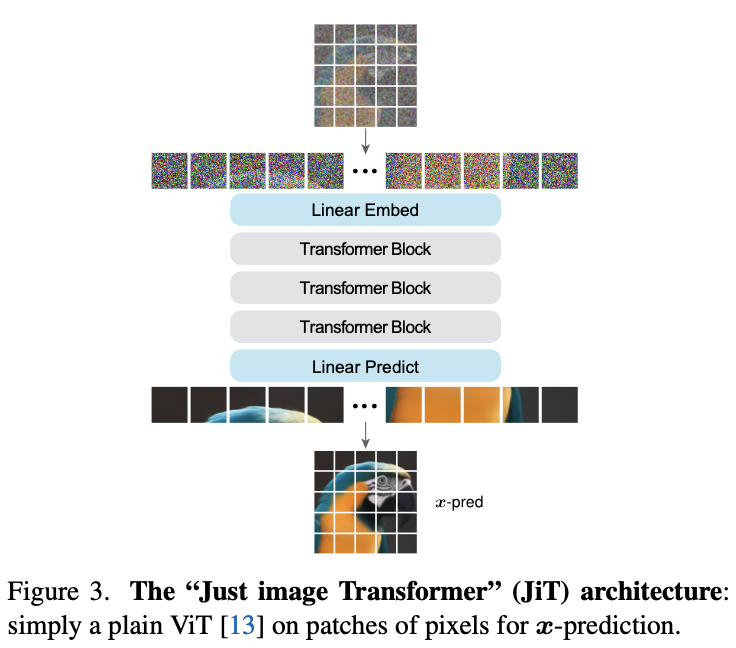
3.1 Just Image Transformers
JiT의 구조는 기존 plain ViT를 사용한다.
3.2 What to Predict by the Network?
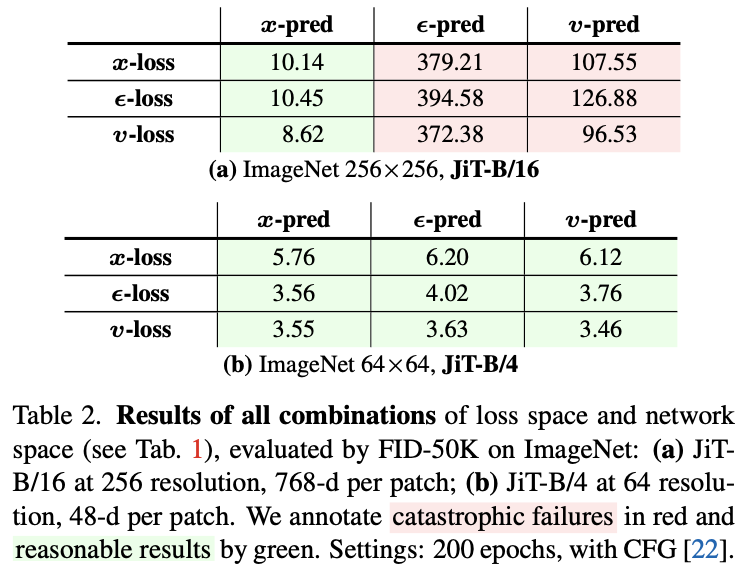
Table 2를 보면, $x$-prediction만 결과가 좋다. 그리고 loss는 크게 중요하지 않다는 것을 보인다. $t$를 샘플링하는 함수로는 logit-normal을 사용한다.

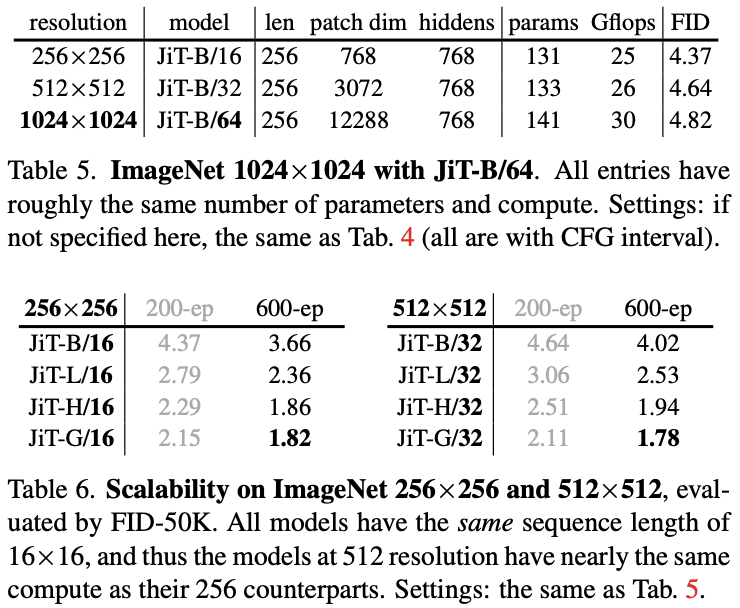
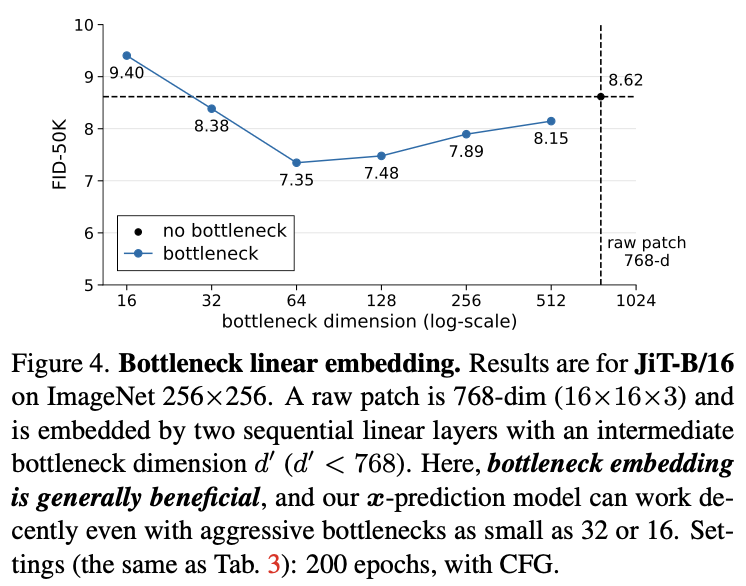
Hidden units의 수는 결정적이지 않고, network의 dimensionality를 줄이는 bottleneck을 도입하는게 효과적일 수 있다.
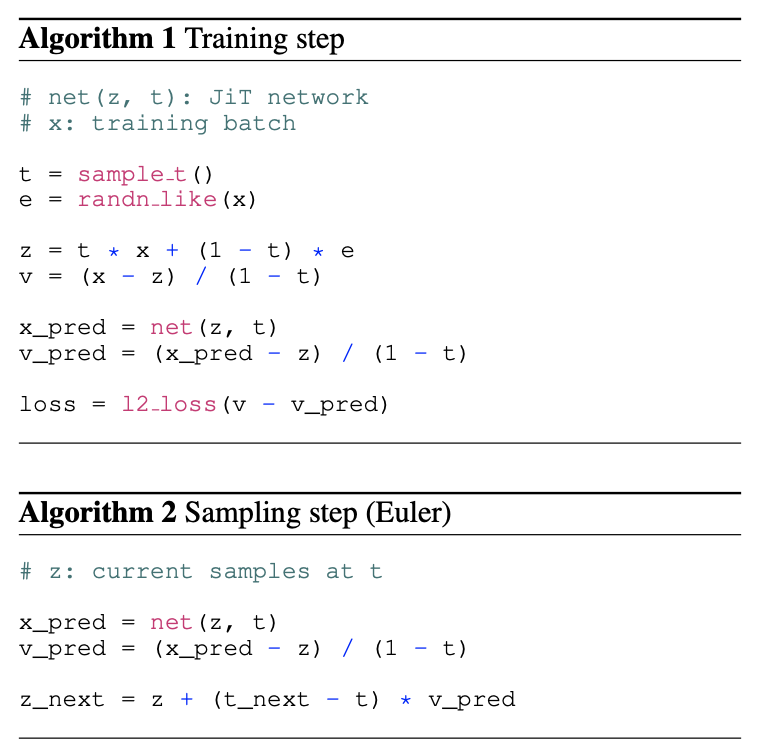
3.3 Algorithms
3.4 "Just Advanced" Transformers
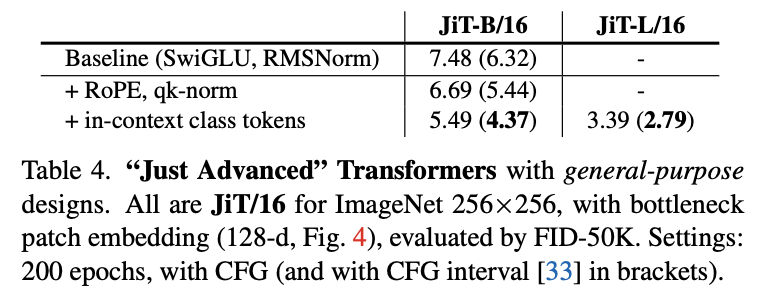
4. Comparisons